Trajectory
Building sustainable systems through engineering, experimentation, and discipline
Engineering Foundations
Execution Model
I approach software as a long-term product, not a short-term project.
I follow iterative delivery through Agile practices, clear sprint goals, and continuous feedback loops. I pair-program with agentic coding tools like Codex, Claude Code, and Antigravity to accelerate development while preserving architectural clarity.
For quality assurance, I rely on automated and scenario-driven testing using Selenium and ZeuZ. Infrastructure is provisioned through Terraform with reproducible environments.
I work primarily on AWS and Google Cloud Platform, and I often choose DigitalOcean when cost-efficiency matters without sacrificing reliability.
The goal is simple: predictable delivery, measurable quality, and systems that remain stable under change.
My process follows a structured lifecycle:
Problem Analysis & Modeling
This phase focuses on understanding business objectives, operational constraints, and system requirements through structured analysis. It involves identifying core problems, defining system boundaries, and creating conceptual and logical models that guide architectural and implementation decisions.
System Architecture & Design
This stage establishes the overall system structure, component interactions, data flows, and technology stack. It ensures that the system meets requirements for scalability, security, maintainability, and performance while aligning with organizational standards.
System Development & Optimization
This phase converts system designs into functional, production-ready solutions through disciplined implementation and continuous improvement. It emphasizes code quality, testing, performance tuning, and institutionalizing best practices for long-term sustainability.
Infrastructure & Scalability Engineering
This stage focuses on designing and implementing infrastructure that supports system availability, scalability, and service reliability. It includes capacity planning, deployment architecture, and operational readiness for growth.
System Deployment & Launch
This phase manages the controlled release of systems into production environments. It ensures deployment stability, configuration accuracy, user readiness, and alignment with operational and business stakeholders.
IT Service Management & Operations
This stage governs the ongoing operation, security, and sustainability of systems in production. It establishes monitoring, incident management, compliance, and continuous improvement processes to maintain service quality.
System Lifecycle
Let's say I have to design and lead the development of an AI-Powered Inventory Platform. Here's my process -
Career Chapters
From curiosity to building stuff.
From Robotics to Software.
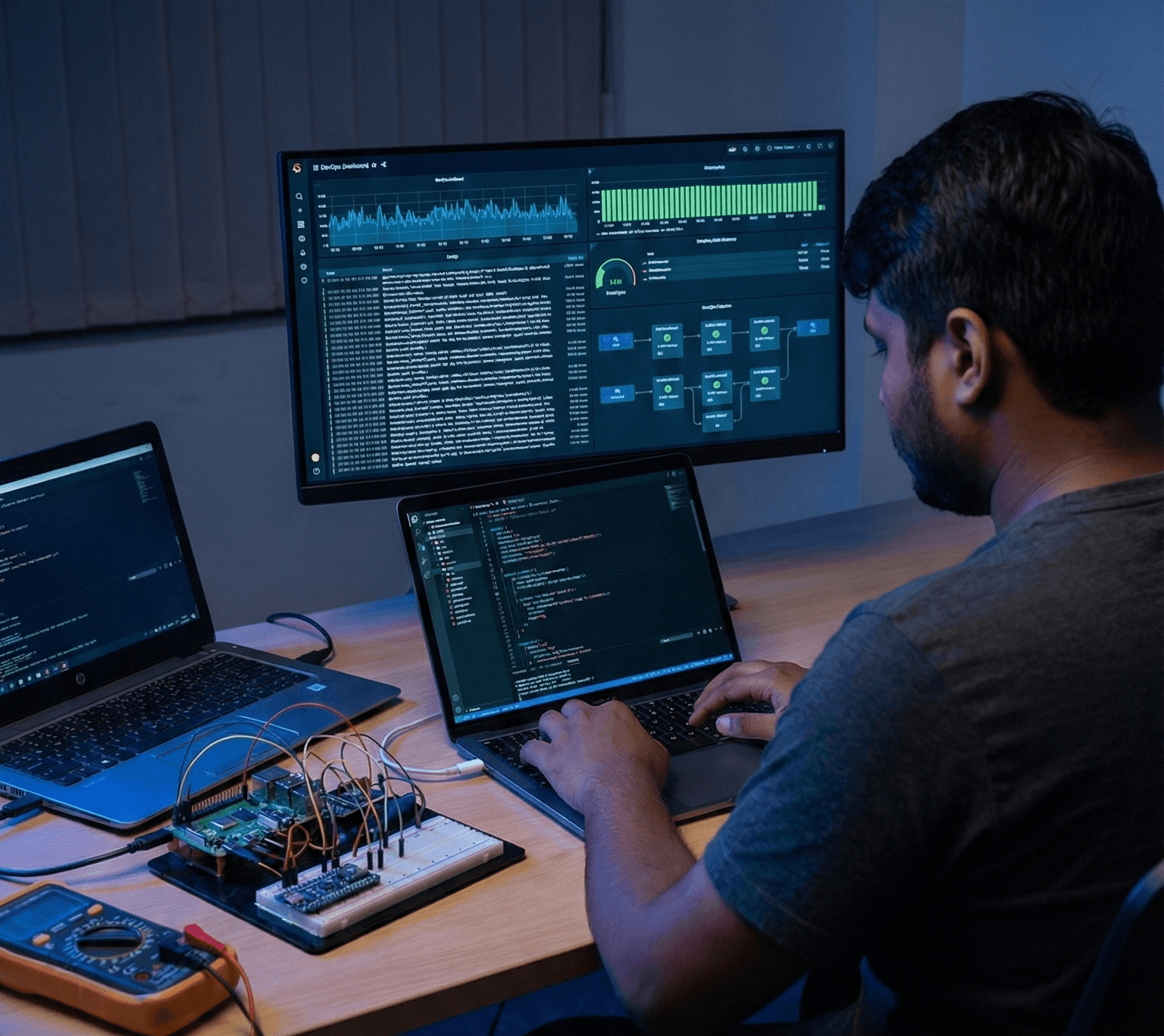
My early technical journey was deeply rooted in robotics and hardware-intensive systems. However, in my country, the practical scope of large-scale robotics development remains limited due to high hardware costs, expensive semiconductor components, and relatively low mass adoption of automation technologies. These constraints make sustained innovation and commercialization in robotics challenging.
In contrast, software engineering and artificial intelligence present immediate and scalable opportunities, as computers and mobile devices are widely accessible to the general population. AI represents the current technological revolution, enabling intelligent systems to be deployed at scale with minimal hardware dependency. Looking ahead, augmented and virtual reality are expected to become mainstream as devices become more affordable, allowing users to experience immersive digital environments.
This evolution will eventually accelerate the next major phase of robotics, driven by increasing demand for large-scale manual labor automation and continuous advances in computing, sensing, and control technologies. My transition to professional software development reflects a strategic alignment with this technological trajectory and long-term innovation potential.